• Skip to primary navigation
  • Skip to main content
  • Skip to footer
Kimberton Waldorf School

Kimberton Waldorf School

Education That Matters

  • quicklinks
    • Calendar
      • 2026-2027 Calendar Summary
    • October FFT Lunch Menu
    • School District Transportation
    • Logins
      • Student Login
      • Teacher Portal
      • BigSis Student Management
      • Parent Square
      • FACTS Tuition Management
    • Frequently Asked Questions
    • Buy KWS Gear
    • Buy KWS Athletic Wear
    • Campus Map
    • Waldorf 101
    • Winter Social Craft Fair
    • Summer Camp
    • Bard Summer Camp
  • 🔍 Search
  • Alumni Reunion
  • ♡ Donate
  • ✎ Apply Now
  • About
    • KWS History
    • Staff
    • Mission & Values
    • Governance
    • Employment
    • What Makes Us Unique
    • Diversity and Inclusion
      • D&I Resources
    • Organic Lunch Program
    • Resources
      • In the Classroom
      • Bringing Waldorf Home
  • Admissions
    • Admissions Process
    • Events
    • Tuition & Tuition Assistance
    • International Students
  • Curriculum
    • Early Childhood
      • Parent Child
      • Rosebud Garden
      • Kindergarten
    • Lower School
    • High School
    • Arts
      • Blacksmithing
      • Clay & Sculpture
      • Eurythmy
      • Handwork
      • Music
      • Painting
      • Theatre
      • Woodworking
    • Athletics
    • Gardening
    • Library
    • College Guidance
  • Support
    • Annual Fund
    • EITC Program
    • Targeted Giving
      • Scholarships
      • Campus Maintenance & Beautification
      • Endowment
    • Beneficiary & Bequest Planning
    • Other Ways of Giving
    • Donation Policies & Information
    • Spring Benefit & Auction
  • Alumni
  • Blog
  • Contact
    • Contact
    • Visit Us

Art Gallery

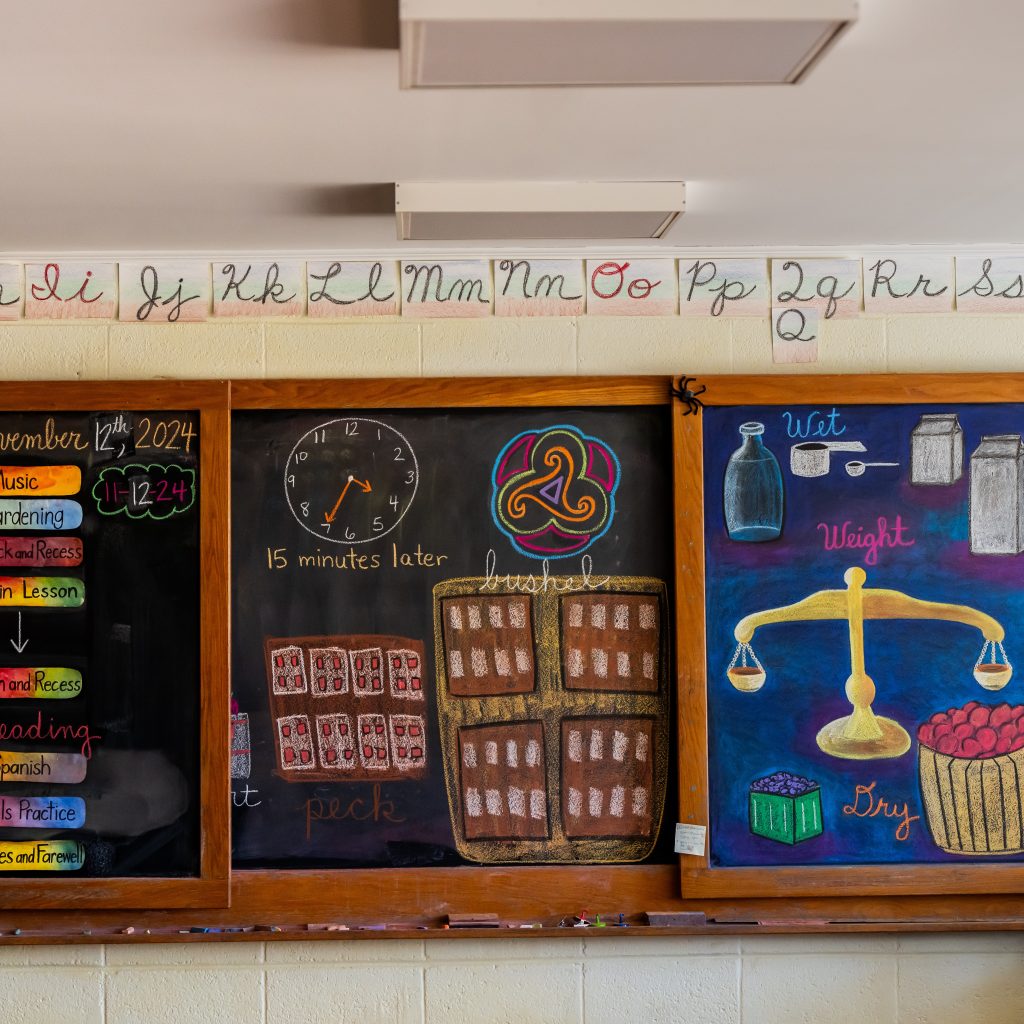
Let’s talk about Chalkboard Art

May 20, 2026 by Katherine Zuber

In a Waldorf school, the chalkboard is so much more than a teaching tool – it is a living piece of the classroom. Each drawing is created by hand by the teacher, often changing with the seasons, the curriculum, and the developmental stage of the children. From vibrant nature scenes to historical storytelling, geometric forms, poetry, and scientific illustrations, chalkboard art helps bring lessons to life in a beautiful and meaningful way.

In Waldorf education, beauty and imagination are considered essential parts of learning. These artistic classroom experiences invite students into wonder, help cultivate focus and reverence, and create an environment where learning feels alive and inspiring.

We are endlessly amazed by the creativity, care, and talent of our teachers, who spend countless hours transforming their classrooms with these incredible works of art. Every chalk drawing is a gift to the students, and a reflection of the love and intentionality woven into daily life at Kimberton Waldorf School.

Filed Under: Art Gallery, Head, Heart and Hands: Teaching the Whole Child, In the Classroom

Senior Self Portraits 2026

March 5, 2026 by Katherine Zuber

There is a special kind of quiet in the studio these days. Our seniors are deep in concentration, working on their final self-portrait projects.

With mirror work and printed photos of themselves, they practice the art of truly seeing. This isn’t just about capturing likeness; it’s about reflection in every sense of the word. Each brushstroke asks for focus, patience, and dedication – the same qualities that have carried them through their Waldorf journey. To look at oneself honestly, to observe light and shadow, strength and subtlety, requires courage and presence.

In Waldorf education, the senior self-portrait is more than a culminating art project. It is a moment of pause before graduation, a chance to reflect inwardly while creating outwardly. As they prepare to step into the wider world, our students first take the time to meet themselves with attention, care, and intention. Thank you Ms. Oswald for guiding them!

Filed Under: Art Gallery, Blog, High School, In the Classroom

12th Grade Sculpting the Human Figure

December 11, 2025 by Kimberton Waldorf School

by Hilla Haut, Arts Teacher

Sculpting the human figure in an expressive, emotionally charged pose is one of the most challenging-and rewarding-artistic tasks. This project serves as the culmination of the 3-D sculptural curriculum, bringing together the techniques and artistic understanding students have developed over the years, including clay work, individual artistic “fingerprint,” and knowledge of human proportions.

In this block, students studied human-figure sculptures by several artists, focusing especially on Ernst Barlach (1870–1938), a German sculptor known for his powerful emotional forms, and Edgar Degas (1834–1917), a French Impressionist whose work includes dynamic studies of movement and the human body. Students observed how these artists conveyed emotion, gesture, and movement, as well as the practical solutions they used to create balanced and stable sculptures.

Students practiced quick gesture drawings and completed a series of short clay studies in various poses exploring movement and emotional expression. Each student then created two original concept sketches for a human-figure sculpture, each expressing a strong feeling or inner gesture through form and posture. From these, they selected one concept to develop into their final piece.

Throughout the process, students focused on body position, posture, and movement, body proportions, the use of negative space, planning and constructing a balanced sculpture, clay sculpting techniques, including additive and reductive methods and creating surface textures that support and complete the expressive quality of the work.

Filed Under: Art Gallery, Blog, Head, Heart and Hands: Teaching the Whole Child, High School, In the Classroom, Resources

Ninth Grade Black and White Portraits

October 9, 2025 by Katherine Zuber

In ninth grade, students engage deeply with their 20th Century History block through a black-and-white portrait project that brings historical figures vividly to life. Each student chooses an influential person from the era, studies their biography and historical context, and creates a black-and-white painting of their face. Working without color challenges students to focus on proportion, light and shadow, expression, and character—learning how a face is structured and how subtle contrasts can convey mood and meaning. The project culminates in a living history experience: students dress as their chosen figure, embody their voice and perspective, and present to their classmates, transforming research into a dynamic, memorable encounter with history.

This artistic work also plays an important role in the long arc of the high school curriculum. The black-and-white portrait lays a technical and developmental foundation for later artistic growth, teaching students how to truly see a face before adding the complexity of color. Three years later, students return to portraiture with a full-color self-portrait, rendered in vivid detail and personal expression. By revisiting and expanding these skills over time, students experience how patience, practice, and self-reflection lead to mastery—mirroring both their artistic development and their growing sense of self.

Filed Under: Art Gallery, Blog, Head, Heart and Hands: Teaching the Whole Child, High School, Resources

Class of 2025 Self-Portraits

May 16, 2025 by Katherine Zuber

“Knowing yourself is the beginning of all wisdom.” -Aristotle 🎨

In the Waldorf curriculum, the self-portrait is more than an artistic exercise – it is a moment of reflection, self-discovery, and inner development. For our seniors, this final self-portrait marks a significant threshold: a chance to look inward, acknowledge their growth, and honor who they have become before stepping into the world beyond High School.

With deep reverence, we share these portraits – each one a quiet testament to the unfolding of individuality, creativity, and courage.

Filed Under: Art Gallery, Blog, High School, Homepage, Resources

Form Drawing: What is this Unique Waldorf School Subject?

March 30, 2021 by Kimberton Waldorf School

At Kimberton Waldorf School students in grades 1-5 typically participate in a subject that is unique to Waldorf schools: Form Drawing. Form drawing can be described as freehand drawing of patterns (often repeating forms) that introduces form and movement to our students. The practice of form drawing helps the students integrate developmental reflexes, develops fine and gross motor skills, eye-hand coordination, and control of movement. Form drawing also lays the groundwork for the study of geometry and geometric drawing which is introduced in 6th grade. Learn more about form drawing in Waldorf schools here from the Association of Waldorf Schools in North America:

Read more about form drawing in Waldorf Schools here

Filed Under: Art Gallery, Head, Heart and Hands: Teaching the Whole Child, Resources

The Self Portrait

May 13, 2019 by Kimberton Waldorf School

Donate Today!

Do you believe that education can — and should! — develop well-rounded individuals?
If so, then consider a donation today!

Donate

“Knowing yourself is the beginning of all wisdom.” – Aristotle

We are not an art school but every senior at KWS paints a self portrait.  This not only represents the culmination of the Waldorf painting curriculum, but requires students to engage with the deep questions of identity:  “Who am I?”, “How am I seen?” and, most importantly, “What is my place in the world?”

In high school, a new questioning about life and the personal search for truth and self-knowledge emerges and students are ready to confront good and evil, questions of destiny, evolution, and identity.  Through the self-portrait project students are challenged to really look at themselves closely to create a physical likeness but to also look deeply at who they are in this world.

Our high school curriculum encourages students to look at themselves, reflect back on their lives and go out into the world and contribute to it from the sense of who they are.

When students graduate from Kimberton Waldorf School, they leave with not only a strong academic foundation but with a sense of who they are, the ability to think for themselves, and the confidence in their capacity to learn and do whatever they put their minds to.

“The senior portrait class represents the culmination of the Waldorf painting curriculum, making use of all the years that come before it in the pursuit of a meaningful piece of art that students and their families can take with them and cherish for years beyond graduation. Pulling from drawing tools introduced and sharpened in 9th grade, painting technique developed in 10th grade, and color theory explored in 11th grade, seniors work for about two months to produce a self portrait that expresses their inner spirit coming into harmony with the external realities of their body.

“The potential for such a portrait is boundless, and seniors are often at first a little daunted. First of all, there is the hard work of really looking at themselves, of being objective and making measurements about things that often times they don’t want to dwell on. Throughout the course, students have to learn to be comfortable with how they look, and in doing so they come to understand that they themselves are beautiful despite what they think of as imperfections. The second daunting task comes in dealing with the number of choices they must make. Do they paint a realistic skin tone, or one that expresses some quality of themselves more metaphorically? Do they choose a background that puts them firmly rooted in the world, or do they paint one that uses color to make it, as we like to say in the painting room, “pop”? How do they pose for their initial photo session, which determines the basic structure of their drawing? The best way to answer these questions is always to jump right in, to do something fearlessly and know that mistakes are where the good stuff happens — learning, growing, correcting. One choice leads to another, which leads to another, and eventually the final outcome looks as if it couldn’t have been painted any other way.”  – Todd Stong, KWS Painting Teacher

This is EDUCATION THAT MATTERS.

Filed Under: Art Gallery, High School, In the Classroom, Resources

Seventh Grade: Charcoal and Pencil Drawings

March 18, 2016 by Kimberton Waldorf School

In 7th grade, there is a growing awareness of fact with an active outer prospective. Science and mathematics come together with work on perspective and drawing with the art curriculum. Exploration of light and shadow reflect these changes within a middle school student.

Filed Under: Art Gallery, In the Classroom, Resources

Second Grade: Paintings from Fables

March 14, 2016 by Kimberton Waldorf School

Fables play a vital role in role in the Second Grade. From retelling the stories to the child-generated writing, fables reflex the awakening of children’s awareness about their own qualities and those of others. From characters that have less desirable qualities to those that embody the ideal, second grades bring them into their learning and their play making to create a strong picture of morality and responsibility.

Filed Under: Art Gallery, In the Classroom, Resources

Eighth Grade: Platonic Solids

March 4, 2016 by Kimberton Waldorf School

From First Grade, Waldorf students begin their study of geometry with simple lines and forms. By Eighth Grade, students see shapes not as simple forms but with unique qualities in the pattern of nature, much like the students themselves.

Filed Under: Art Gallery, In the Classroom, Resources

High school: Landscape Studies

February 26, 2016 by Kimberton Waldorf School

Waldorf High School students travel through time and cultures in their language and history curriculums. There art reflects those journeys. Students learn
to see artworks of each culture as symbolic of the consciousness of the people in
a particular place at a given time. Students work with a variety of mediums to create landscapes reflective of their thoughts and ideas.

Filed Under: Art Gallery, High School, In the Classroom, Resources

Twelfth Grade: Children’s Zoology Books

February 12, 2016 by Kimberton Waldorf School

Reflecting back on a rich journey through the grades, this project captures the relationship of science, art, and writing that embodies an immersive curriculum. In their Zoology books, seniors showcase how subject areas come together and how writers of fiction can reflect facts from the world around them.

Filed Under: Art Gallery, High School, In the Classroom, Resources

Eighth Grade: History of the Reformation

February 12, 2016 by Kimberton Waldorf School

The Reformation is not studied as just a religious event in Eighth Grade but as political and cultural one as well. The ideals of universal rights are brought back from previous history lessons integrating with the observational skills of portrait drawing.

Filed Under: Art Gallery, In the Classroom, Lower School, Resources

Eighth Grade: Scratchboard Art

January 24, 2016 by Kimberton Waldorf School

Scratch-board art from the 8th grade at Kimberton Waldorf School.

Filed Under: Art Gallery, In the Classroom, Lower School, Resources

Second Grade: Snowman Paintings

January 22, 2016 by Kimberton Waldorf School

Painting by some of the second graders at Kimberton Waldorf School.

Filed Under: Art Gallery, In the Classroom, Lower School

Footer

Connect

  • Facebook
  • Instagram
  • Twitter

Contact

410 West Seven Stars Road,
Phoenixville, PA 19460
Email us directly here

ph:610.933.3635  f:610.300.5488


Join our newsletter

Name

Menu

  • Current Students
  • Admissions
  • Faculty & Staff
  • Curriculum
  • Contact
  • Employment

Copyright © 2026 Kimberton Waldorf School

  • HOME
    • What Makes Us Unique
  • About
    • KWS History
    • Mission & Values
    • Governance
    • Faculty & Staff
    • Organic Lunch Program
    • Employment
    • Resources
      • In the Classroom
      • Bringing Waldorf Home
      • Working Towards a Better World
  • Admissions
    • Admissions Process
    • Tuition & Tuition Assistance
    • Events
    • International Students
  • Curriculum
    • Early Childhood
      • Parent Child
      • Rosebud Garden
      • Kindergarten
    • Lower School
    • High School
  • Support
    • Annual Fund
    • EITC Program
    • Targeted Giving
      • Scholarships
      • Campus Maintenance & Beautification
      • Endowment
    • Beneficiary & Bequest Planning
    • Other Ways of Giving
    • Donation Policies & Information
  • Alumni
  • Quicklinks
    • Calendars & Contact
    • Student Login
    • BigSis Portal Login
    • October 2026 FFT Menu
    • School District Transportation
    • Campus Map
    • Buy KWS Gear
    • Buy KWS Athletic Gear
    • Summer Camp
  • Contact
  • Visit Us
  • Summer Camp
  • Blog