• HOME
    ▼
    • What Makes Us Unique
  • About
    ▼
    • KWS History
    • Mission & Values
    • Governance
    • Faculty & Staff
    • Organic Lunch Program
    • Employment
    • Resources
      ▼
      • In the Classroom
      • Bringing Waldorf Home
      • Working Towards a Better World
  • Admissions
    ▼
    • Admissions Process
    • Tuition & Tuition Assistance
    • Events
    • International Students
  • Curriculum
    ▼
    • Early Childhood
      ▼
      • Parent Child
      • Rosebud Garden
      • Kindergarten
    • Lower School
    • High School
  • Support
    ▼
    • Annual Fund
    • EITC Program
    • Targeted Giving
      ▼
      • Scholarships
      • Campus Maintenance & Beautification
      • Endowment
    • Beneficiary & Bequest Planning
    • Other Ways of Giving
    • Donation Policies & Information
  • Alumni
  • Quicklinks
    ▼
    • Calendars & Contact
    • Student Login
    • BigSis Portal Login
    • October 2026 FFT Menu
    • November 2026 FFT Menu
    • School District Transportation
    • Campus Map
    • Buy KWS Gear
    • Buy KWS Athletic Gear
    • Winter Social Craft Fair
    • Summer Camp
  • Contact
  • Visit Us
  • Summer Camp
  • Blog
  • Skip to primary navigation
  • Skip to main content
  • Skip to footer
Kimberton Waldorf School

Kimberton Waldorf School

Education That Matters

  • quicklinks
    • Calendar
      • 2026-2027 Calendar Summary
    • November FFT Lunch Menu
    • School District Transportation
    • Logins
      • Student Login
      • Teacher Portal
      • BigSis Student Management
      • Parent Square
      • FACTS Tuition Management
    • Frequently Asked Questions
    • Buy KWS Gear
    • Buy KWS Athletic Wear
    • Campus Map
    • Waldorf 101
    • Summer Camp
    • Bard Summer Camp
  • Winter Social Craft Fair
  • 🔍 Search
  • ♡ Donate
  • ✎ Apply Now
  • About
    • KWS History
    • Staff
    • Mission & Values
    • Governance
    • Employment
    • What Makes Us Unique
    • Diversity and Inclusion
      • D&I Resources
    • Organic Lunch Program
    • Resources
      • In the Classroom
      • Bringing Waldorf Home
  • Admissions
    • Admissions Process
    • Events
    • Tuition & Tuition Assistance
    • International Students
  • Curriculum
    • Early Childhood
      • Parent Child
      • Rosebud Garden
      • Kindergarten
    • Lower School
    • High School
    • Arts
      • Blacksmithing
      • Clay & Sculpture
      • Eurythmy
      • Handwork
      • Music
      • Painting
      • Theatre
      • Woodworking
    • Athletics
    • Gardening
    • Library
    • College Guidance
  • Support
    • Annual Fund
    • EITC Program
    • Targeted Giving
      • Scholarships
      • Campus Maintenance & Beautification
      • Endowment
    • Beneficiary & Bequest Planning
    • Other Ways of Giving
    • Donation Policies & Information
    • Spring Benefit & Auction
  • Alumni
  • Blog
  • Contact
    • Contact
    • Visit Us

Katherine Zuber

Building Stronger Minds with Mental Math at Kimberton Waldorf School

November 2, 2026 by Katherine Zuber

by Julia Krumenacker | chestercounty-life.com

When we consider mental math these days, our initial opinion may be why bother? Current technology provides access to a calculator at our fingertips, so calculating math in our head may seem like a waste of time. However, the time spent is a serious investment in not only brain development, but overall mental health.

Mental math, the process of completing math in your head, without any tools, such as a calculator, pen, or paper has been shown to enhance children’s brain development and boost overall learning capabilities. Numerous studies demonstrate that mental math helps kids understand and process complex concepts along with developing other skill sets, such as increased concentration levels, better focus, self-confidence, and the ability to think logically through situations. Mental math has even been connected to improved emotional health, as an antidote for anxiety and depression.

At Kimberton Waldorf School, mental math is a strong component of the curriculum, starting in the younger grades and utilized straight through to advanced Upper School math instruction. Waldorf teachers understand that mental math is not only crucial ti learning more advanced mathematical concepts, but also strengthens working memory and a comprehensive ability to solve problems.

“In typical math instruction today, there is so much emphasis on the procedure that you never reach the thinking skills that allow you to use the procedure,” explained former math teacher and mentor, Carmen Maciarello. “It is not teaching real-world problem-solving. We are living in a world of numbers, not procedure. Numbers manifest everywhere. Math shows up in music, science, the natural world, and in a bit of all daily activities. So in teaching mental math, we are using a basic practice to mold and form the capacities for life.”

Serving children from early childhood through grade 12, Kimberton Waldorf School is rooted int he principles and philosophy of Rudolf Steiner. A Waldorf education addresses the physical, emotional, and intellectual capacities of children with movement, fine and practical arts, together with the study of humanities, science, math, and technology. The school’s mission is to educate the whole child: mind, heart, and hands. Kimberton Waldorf is a place where students are inspired to be creative thinkers and doers, cultivating their intellectual, emotional, and physical capabilities, allowing students to grow into confident, capable adults.

“You will see mental math being practiced every day at Kimberton Waldorf,” noted Carmen. “Mental math is an important bridge between teaching a concept in an exploratory way and teaching a procedure, or accepted algorithm to solve a problem. Math should be stimulating and exciting. When you walk into any one of our math classrooms, you’ll see that our kids just love mental math. In the younger grades, teachers will pose a problem, and hands will shoot up into the air. We ask, how did you get there? We allow each student to share both standard and non-standard methods of correctly answering a problem. They realize there is never just one way to arrive at the correct answer, and this process is fascinating to them. There is an authentic engagement and excitement in these math classes.”

Innumeracy, the mathematical equivalent to illiteracy, is concerning. Recent PISA (Programme for International Student Assessment) scores, which measure a 15-year-old’s ability to use reading, science, and math knowledge skills to meet real-life challenges, were released at the end of 2019. The United States ranked 38th in math.

“I really think that the traditional way of teaching math in our country is focused on answer-getting rather than problem-solving, which is worsening this situation,” stated Carmen. “At Kimberton Waldorf, we teach math in a way that allows students to slow down and extend the thought process around numerical problems, which deepens understanding. We allow math to be practiced in a satisfying and immersive way. It is not a mechanistic approach. We foster creative problem-solving, which trains independent thinking. It’s so much more than just learning a schema. Rather, it’s an avenue of supporting students to open up their minds so they are able to use their intuition. The journey to arrive at a particular answer becomes a huge motivator, while also leading to fluency in numbers. Any time you are utilizing mental math, you become better at following through on a concept. This process helps you become better in any activity or endeavor. For example, in music you may be able to memorize and play a tune in your head. From there, you are able to add instruments. Then you develop the ability to know the appropriate key. You are building your music skills and thus becoming a better musician.”

Neuroscience researchers at Duke University recently found that engaging a specific part of the brain during mental math may benefit emotional health. Their work provides evidence that memory-based math problems stimulate the dorsolateral prefontal cortex, the region of the brain linked to depression and anxiety. The more active this portion of the brain became while engaged in mental math, the more likely individuals were to adapt their thoughts about emotionally difficult situations and not become entrenched into one way of thinking, lessening these symptoms. The results of their study also indicated that those with higher dorsolateral prefrontal activity were less likely to suffer a mental illness diagnosis.

“The process of slowing down and considering alternatives in math utilizes the same part of the brain that aids in resolving emotional issues,” added Carmen. “This link reveals the connection anxiety. You are able to effectively problem-solve and arrive at solutions.

“At Kimberton Waldorf, we try to understand how kids learn and how they make sense of the world,” continued Carmen. “There is an objective truth in math that is replicated everywhere in the world. So, we approach math differently. We instill enthusiasm for learning and encourage creative and divergent thinking. By utilizing mental math, we build character traits of persistence, patience, and the ability to work through mistakes.”

For 100 years, Waldorf education has been providing education that engages the senses, builds capacities, and inspires learning.

Filed Under: Kimberton Making News, Lower School

History Through Music Main Lesson Books

October 21, 2026 by Katherine Zuber

The Main Lesson books for 11th grade’s History Through Music block are an impressive and expressive guide to the ways these students use music to help them walk through life.

By creating their own record albums, they thoughtfully curated the soundtrack to their lives, explaining their choices in depth while also writing essays on the historical significance of music throughout time.

Filed Under: High School

9th Grade Agricultural Practicum

October 15, 2026 by Katherine Zuber

Last week 9th grade spent their week at Camphill Village Kimberton Hills as part of their Agriculture Practicum. Together they weeded, harvested, washed and packed vegetables for the CSA, and helped the villagers and staff in many other ways!

In the evenings the class gathered and slept in our garden building, bonding over the power of manual labor and their shared love of being outdoors. Thank you Camphill for having us! What a glorious week to spend in your community.

Filed Under: High School, Homepage

Michaelmas Festival

October 5, 2026 by Katherine Zuber

Under brilliant blue skies and the golden light of early autumn, our entire school gathered below Shouting Hill for one of our most beloved Waldorf traditions: the Michaelmas festival.

In the Waldorf tradition, Michaelmas is a time to meet the changing season with courage, purpose, and inner strength. The festival honors the archangel Michael, whose image is often depicted with a sword, standing courageously before and overcoming a dragon.

The dragon is a powerful symbol in the Michaelmas story. It represents the forces of fear, uncertainty, and those challenges – both within ourselves and in the world around us – that can seem overwhelming. Michael’s victory over the dragon is not simply a story of good conquering evil; it is an image of the human being finding the courage, strength, and clarity to meet what is difficult rather than turn away.

At Michaelmas, these ancient images come alive through the traditions of the festival: the procession, songs and verses, movement, seasonal activities, and the joyful gathering of the whole school community. For our children, the story of Michael and the dragon becomes an invitation to cultivate their own courage – to stand tall, face challenges, and bring light and purpose into the world.

And what a glorious day to celebrate! Beneath the autumn sky, our school community came together below Shouting Hill to honor this treasured tradition and welcome the turning of the season.

Filed Under: Head, Heart and Hands: Teaching the Whole Child, Homepage

Seniors Voyage to Hermit Island, Maine

September 29, 2026 by Katherine Zuber

Each year, as our seniors step into their final year together, they make their way to Hermit Island in coastal Maine for a week of learning, exploration, connection, and adventure.

Joining 12th-grade students from Waldorf schools across the region, our seniors study the remarkable life of the Maine coast: from lobsters and barnacles to sea stars, clams, snails, squids, and countless other creatures. The students also capture some of the beauty in their watercolor sea-scape lab. In the poetry lab, the students create personal pieces of writing while reflecting on the beauty and emotions brought up in such a magical place.

And beyond the classroom, there are sandy beaches, warm September waters, cool nights around the campfire, new friendships, and the simple joy of being together in a beautiful place. Thank you Hermit Island! Here’s to an incredible year, class of 2027.

Photos by Jen Zahorchak from Lake Champlain Waldorf School and Celia Martin from KWS.

Filed Under: High School, Homepage

Invest in ergonomically friendly tools in retirement

September 24, 2026 by Katherine Zuber

Tools that work with you can make the kitchen experience more joyful.

Article in the Reading Eagle written by KWS parent Courtney Diener-Stokes about KWS Woodworking teacher James Pierson

Invest in ergonomically friendly tools in retirement

When people retire, many have bucket list items to check off on their list that involve travel and unique experiences, but there are some who simply choose to be more present and intentional within their everyday lives.

That includes time spent in the kitchen cooking and experimenting without time constraints smothering any joy that might be had there.

One’s financial situation can impact decisions made, regardless of whether it’s time spent on the golf course; going on a new adventure; when cooking or entertaining and deciding to buy ingredients for six to host a dinner party; or a cozy late summer alfresco meal for two with a glass of wine under the stars.

Tools and accessories

Your kitchen is most likely stocked with the tools and accessories you have accumulated that are needed to execute your culinary vision.

Many of those items and their quality were typically driven by your financial picture at the time and whether or not you were looking for something to simply do the job or an item of quality to add to your collection, such as a custom wooden spoon that takes ergonomics in mind, complementing your bodily motions because it was made to work with you instead of you having to adjust your grip or movement to work with something that was not thoughtfully designed.

Some handcrafted spoons by artist James Pierson. (Courtney Diener-Stokes)

When artist James Pierson spends time in his studio in Exton, Chester County, making handcrafted wooden utensils among other creations, there is more of a thought and design process involved than meets the eye.

More enjoyable experience

The end result is a product that conforms to you, not one that you have to conform to, enabling it to work with you in a way that it is comfortable and beneficial for your everyday motions in the kitchen. That’s typically a more enjoyable experience because your body‘s natural motions are being taken into consideration. The thoughtfulness is more inclined to complement your dexterity, which declines as you age.

When designing wooden kitchen tools, James Pierson keeps ergonomics in mind. (Courtney Diener-Stokes)

“I want the things I make to be both beautiful and genuinely useful,” Pierson said. “Within my craftsmanship, ergonomics starts with paying attention to the hand and to how a tool is actually used.”

Most of the time he doesn’t begin with a strict formula.

“I shape a piece, hold it, move it through the kinds of motions someone would use while cooking, and keep refining it until it feels natural,” he said. “I think about balance, weight, handle thickness, pressure points, leverage, and the transition between the handle and the working end of the utensil.”

He sometimes will design based more on aesthetics, for example when he uses the lathe to shape a handle, but even then his experience gives him knowledge as to what is likely comfortable and functional.

Practical arts teacher

Pierson, who is also a woodworking and practical arts teacher at Kimberton Waldorf School in Chester County, uses many of the tools he makes in his own kitchen located on the same property as his studio.

“That gives me a chance to test them over time rather than simply imagining how they might work,” Pierson said. “I notice what feels comfortable, where something could be improved, and what I might change in the next version.

“In that sense, I’ve probably learned as much about designing kitchen tools at the stove as I have at the workbench.”

He said that every piece he makes teaches him something.

“On some of my longer spoons and spatulas, for example, I carve two shallow recessed areas, or grip coves, into the handle,” he said. “They create two natural holding positions — one allows the user to hold farther back on the utensil for reaching comfortably into a deeper pot. The other lets the user choke up closer to the spoon bowl or working end when more leverage and control are needed, such as when scooping or moving something heavier.

His goal is to let the tool adapt to the task and to the person rather than requiring the person’s wrist, hand, or arm to compensate for the tool.

He explained that those considerations can become even more important as grip strength and fine motor control change with age.

“A utensil that is well balanced, easy to grasp, comfortable in the hand, and doesn’t require excessive force, can make an everyday task easier and more enjoyable,” Pierson said.  “At the same time, I think good ergonomic design benefits everyone, not only older adults.”

Good craftsmanship

When he thinks about ease of use, his ideal is that the tool almost disappears into the experience.

“You shouldn’t have to keep thinking about how you’re holding the spoon or fighting with the utensil,” he said. “You should simply be able to cook. To me, good craftsmanship isn’t only about how an object looks when it’s finished. It’s also about how well it serves the person using it.”

For an older adult choosing kitchen utensils or other functional objects, he encourages them to physically pick the item up whenever possible and consider: does it feel secure without requiring a tight grip? Is the handle substantial enough to hold comfortably? Is the weight appropriate? Does it feel balanced and easy to control? Are there uncomfortable edges or pressure points?

“A beautiful object is wonderful, but if it’s meant to be used, it should make the task easier rather than demanding more from the person using it,” he said.

Filed Under: Bringing Waldorf Home, High School, In the Classroom, Kimberton Making News

Rose Ceremony September 2026

September 15, 2026 by Katherine Zuber

A Rose Ceremony to Remember 🌹

Last Friday, our community gathered for one of Kimberton Waldorf School’s most beloved traditions: the Rose Ceremony.

Our 12th graders welcomed their first grade buddies with a rose, marking a beautiful beginning to their journey into the grades. In this simple and meaningful gesture, our oldest students offered a warm welcome to our youngest – creating a bond that will grow and unfold throughout their years together.

A rose, a new beginning, and the passing of a tradition from one generation of students to the next. Welcome to the grades, First Grade! And thank you to our 12th graders for helping make this moment so special.

Filed Under: Head, Heart and Hands: Teaching the Whole Child, Homepage

From Kimberton Waldorf to Building Businesses in Africa

September 10, 2026 by Katherine Zuber

What happens when you graduate from Kimberton Waldorf School, study Biomedical Engineering at Brown University, and then decide not to take the predictable path into consulting or finance? For Kyle Schutter, KWS ’06, it meant choosing the unknown.

After Brown University, Kyle moved toward entrepreneurship and began traveling extensively, including throughout Africa. He has since built businesses there and is now the founder of Kuzana, a company focused on helping entrepreneurs grow their businesses.

Kyle shared that through Kimberton Waldorf School, he become an incredibly well-rounded person who is skilled in not just math and science (his two favorite academic subjects) but music, public speaking, art, creative thinking, on and on. He considers himself an independent thinker and is not afraid to go out into the world and try new things – all skills he honed and mastered here at KWS.

Read below to find out how Kyle credits his Waldorf education with shaping how he approaches life:

I think how the Waldorf education really helped was the deep study of mythology, from the Odyssey to Greek or Norse myths. There is a protagonist and an antagonist. They’re separated as characters, but in reality they’re inside each one of us, and there’s not a separation of good people and bad people but inside every human heart is both. They say when you put ambitious people together they bloom like dying plants given water and that’s what you can find at the Waldorf School.

I never studied abroad in High School but I saw my classmates do it and I thought if they can do it then I can too. After graduation, I started to travel around, first to Peru, then Mexico,  and then traveling across Africa and doing a motorcycle trip through Latin America for three years. It didn’t seem too crazy because I knew people who had done it. It was just putting one foot in front of another so being around ambitious people is probably more important than the teachers I have or what I learn in education. The teachers attract interesting students, then students mold eachother. We learn more from our peers than anyone else.

Though now I’m a businessman I think of myself more as an artist who paints with money. Painting on canvas is so 1600s. The next new art isn’t even recognized as art yet. I want to build something interesting in the world. I want to prove my art and paint on a bigger and bigger canvas and the money doesn’t really phase me one way or the other.

I have: 

  • a great partner
  • two cats
  • a house that’s small enough I don’t lose things too often
  • a motorcycle

So what else do I need? 

I initially thought I wanted to be a scientist but the highest leverage thing is business and there’s a bit more truth actually in business than science. Better said, the best science doesn’t necessarily happen in a laboratory but in the real world.

There’s a certain pressure that business gives. It’s easy to run a business that loses money but to make a profit you need to: 

  • hold your team accountable
  • reduce theft
  • put systems in place
  • all while motivating a team
  • maintaining your sanity
  • solving a real problem that customers are willing to pay for

At Kuzana.co we are interested in personal transformation through business growth. The pressure of business causes us to become better people.  If an entry-level employee does something unethical, it’s not really a story – but if a big-time entrepreneur CEO does, then it’s a story because we expect more integrity out of them.


There’s a misconception that there’s a lack of integrity in business but reality is the other way around. Probably politics and science and Universities have less integrity than business.  University professors can preach from an ivory tower about what good is but don’t actually make a difference to people who are hungry. where’s the integrity towards actually accomplishing what they preach?  Why do we focus on learning about generals and politicians instead of entrepreneurs? Everything that was ever created in the world was by an entrepreneur. Scientists just came up with the concept. Politicians were paid for by taxes extracted from entrepreneurs who built something that people found useful. Yet you won’t find a class on the history of founders in any school that I’m aware of.  So let’s establish how important ethical wealth creation is.

Our goal at Kuzana is to mint a thousand more dollar millionaires. Imagine what that would do in Kenya if there’s an upper middle class that made money through accountability, through putting systems in place, motivating a team. Imagine how that would change politics, reduce corruption. It would be quite a beautiful art piece.

https://kuzana.co/founder

Filed Under: Alumni, Blog, Kimberton Making News, Resources

KWS Alum Azaria Van Der Stok-Smallwood ’22 Featured in NYOTA Magazine

September 10, 2026 by Katherine Zuber

Full article by Britt Starghill II at NYOTA Magazine.

For Kimberton Waldorf School, the impact of a Waldorf education can often be seen years after a student leaves campus—in the way alumni approach their work, their communities, and the world around them.

We’re delighted to celebrate alum Azaria Van Der Stok-Smallwood (KWS ’22), whose work as an emerging fashion designer was recently featured in NYOTA Magazine.

Azaria’s journey into fashion began long before she entered the world of design. Growing up in a multigenerational Waldorf family, she experienced an education deeply rooted in creativity, handwork, and the natural world. Her grandmother Raymonde van der Stok, a longtime KWS Eurythmy teacher, helped make that Waldorf tradition part of her family’s story.

“[I]t wasn’t even a choice,” Azaria shared with NYOTA. “My grandmother taught there, my mom went, and so did my sister.”

From kindergarten onward, handwork was simply part of everyday life. Azaria learned to knit, crochet, and spin yarn, while time spent outdoors connected those skills to the natural world. She recalls collecting wildflowers from campus, boiling them down to create natural dyes, and using those dyes on yarn.

“It was such a normal thing in the education I grew up in to take from the natural world and create art with what was around you,” she said.

That early experience continues to resonate throughout Azaria’s work today.

From Waldorf Handwork to Fashion as a Visual Language

After graduating from KWS in 2022, Azaria pursued her passion for fashion and design, carrying with her the creative foundation she developed as a Waldorf student.

For Azaria, clothing became much more than an artistic medium. Growing up navigating very different communities and environments, she came to understand the power of clothing to shape perception and communicate identity.

Today, she describes fashion as her way of communicating—a “visual language of dress.” Her work draws on her personal experiences, her community, cultural history, and questions of identity and social justice.

That combination of personal storytelling and social commentary is particularly evident in her recent collection.

Turning Waste Into Beauty

One of Azaria’s favorite pieces from the collection began with something most people would simply throw away: scraps of muslin.

While working in her studio, she collected discarded muslin scraps from pattern-making throughout the year and from other students’ work. She then painstakingly tore the material into strips, transforming the waste into a material resembling raffia.

The finished garment combines a crocheted halter-neck bodice with a dramatic, voluminous skirt made from the repurposed material. The design also incorporates individually hand-collected mussel shells from the shores of Rhode Island.

For Azaria, the piece represents far more than sustainability in fashion. It connects environmental responsibility with Black cultural history, family, place, craft, and the transformative power of making.

She draws a connection between transforming discarded materials into something beautiful and the long history of Black Americans creating nourishment, art, and culture from what society has discarded.

The hours she spent tearing fabric and crocheting by hand also carry meaning for her. She describes the repetitive, meditative nature of these processes as a way of connecting with ancestry and cultural memory.

In many ways, the philosophy behind this collection echoes something deeply familiar to Waldorf education: the value of working with our hands, paying attention to the materials around us, and transforming the ordinary into something meaningful.

A Waldorf Education That Travels With You

Azaria’s story is a beautiful reminder that education is not simply about what students learn while they are at school. It is also about the habits of mind, creative confidence, and relationship to the world that they carry forward.

At Kimberton Waldorf School, we believe that artistic and practical experiences are essential parts of an education. Handwork, movement, music, visual arts, and a connection to nature give students opportunities to experience themselves as capable creators and to see possibility in the world around them.

For Azaria, those experiences became part of the foundation for a career in fashion—one that brings together artistry, cultural storytelling, sustainability, and social awareness.

And her story continues to unfold.

On September 18, Azaria will present her collection at New York Fashion Week. She will also exhibit her thesis collection at an event connected with New York Fashion Week and Climate Week and participate in a discussion about sustainability and fashion design in the contemporary world.

We are proud to celebrate Azaria and to see the creative seeds planted during her years at Kimberton continue to grow.

Congratulations, Azaria! We can’t wait to see where your work takes you next.

Filed Under: Alumni, Blog, Kimberton Making News, Resources

We, the People: The Game

July 10, 2026 by Katherine Zuber

Building a Constitutional Economy in a 10th Grade Waldorf Classroom

by Liz Barrett, English Teacher, Academic Support, Class Advisor

“What’s up CITIZEN-STUDENTS!” I beam, walking into the heart of our classroom. Over time I’ve worked out that this is how to best capture the attention of a group of energetic teens. Today marks class 12 of 22, and for the next 45 minutes we will practice the hard skills of notetaking and critical thinking alongside so-called soft ones – operating by consensus and classroom etiquette. Here, those are treated as hard skills, too. The room gets rowdy, and often, but it’s only the work of a pointed question or two to bring us back. Students in this room are building their own government, modeled on the U.S. Constitution. The process is messy, frustrating, intellectually painful, yet generative. Something larger is at stake: knowledge, and the budding citizens of our world. Rigor can be found in play. I give you, We, the People: The Game – an experimental classroom model for 10th grade U.S. Government.

At the core of my job is preparing students for the myriad paths they’ll walk after graduation. The seeds of what these students will carry into their futures are germinated in this classroom. The stated mission: teach U.S. government. The deeper one: teach these teens how to be students who are critical of how they know what they know. “Studenting” is an art best learned by degrees: assessing sources, refining papers, crafting arguments, and taking notes. None of those skills stick without urgency. So, we build an economy. To create the economy is to create the game.

  This is a class on critical thinking and critical semantics. It’s a class on the importance of the fourth estate. It’s a class about American history, American laws, and American governance. I think—and perhaps I’m biased since I’m the teacher—all of these lessons are deeply important ones. Each citizen-student begins by choosing a keyword from a list of dozens—freedom, democracy, representation, equity, virtue—a term that captures what this country, in their view, should stand for. Then they commit. Week by week, as we learn how our government works, they probe their word’s boundaries. The Keyword: U.S.A. is theirs to defend. 

The economy comes from Thoreau. Teaching Transcendentalist literature last year, I was struck by Thoreau’s economy in Walden. Every nail and every shingle was embedded with worth and accrued through a ledger. In concept and practice that ledger is our backbone. The knowledge we produce together is typed into a shared Doc called “Keeping Receipts,” (now well over 70,000 words), and is a coproduced commons they can all access, anytime,

Here’s how it works: Every comment or question a Citizen-Student offers is tracked by a BANKER, one of a small rotation who also share the duty of surveillance as well as bringing in something newsworthy, like a high school “show-and-tell.” Comments and questions pay 2 cents apiece, a system I dubbed “My 2 Cents.” Attendance varies by role: 5 cents for Citizen-Students, 25 for Bankers. The EXECUTIVE (that’s me) keeps meticulous track of the spreadsheet called “The Market.” The currency, coined by a creative citizen-student, is LizCoin. 

What do they do with the money? Pay taxes! Each week, citizen-students owe at least 250 words on a homework prompt – civil asset forfeiture, keyword definitions, gerrymandering, questions from the text, even meditations on those 3 watershed moments from 1619. That is, they owe the writing or they owe the LizCoin. Set at a market rate, either way they’ll need to pay in labor or in the currency their labor has earned. Whether they pay or write it’s their calculus, drawn from decisions based on their personal ledgers. Penalties and bonuses are also in play. Almost without noticing, they are learning class-by-class how self-interest operates in a public economy. 

The midterm challenge pushed them further. Citizen-students had to identify their 5 state and federal representatives, describe what those representatives do, and formulate one open question for one of them. No boilerplate. They had to look at what these people do for us and figure out how to ask them for help. The questions came back sharp: 

  • “Seeing as you are a member of the House Appropriations Committee, how are you planning to address the expenditures of the war in Iran when contrasted with the declining state of the working class of America?”
  • “As a member of the House Armed Services Committee, with such a large defense budget, how do you make sure the money doesn’t go to waste or is spent on unnecessary programs?”
  • “When I was researching you, I found out you were the first woman to represent Pennsylvania’s 6th district. How did it feel to become the first woman to represent us?”

These are not warm-up questions. These are the questions of constituents.

The game, of course, is more than its ledger. The Bankers are the judiciary, and issues we cannot decide in the room go to them. We have played out diplomatic immunity, file redaction for students on their exchange, critical source analysis, conflict of interest, and the term, “illegal alien.” When a Banker forgot to submit their news, an empathetic majority decided it was only negligence to be fined at the regular market rate, rather than a more gross negligence at double. We have studied demos and kratos, and the Athenian direct democracy that gave birth to these ideals. We have looked at amendment thresholds, conflict of interest, diplomatic immunity, Executive Orders, and who owns our news. 

The data is revealing. Sixty percent of students rated the course “very engaging,” and 93% agreed that earning LizCoin helps them understand “how being active in government or a community can make a difference.” One student reflected: “Communities seem to always balance out in the way that the general whole quietly decide that this certain group of people will always ask the questions for them.” That is a heckuva sentence—one I would equally expect to hear in a graduate seminar.

The critiques are real, too. Some find the LizCoin distracting. Others want less typing and more lecture. One wants the “My Two Cents” system limited to the first part of class. These are legitimate objections, and coincidentally the exact concerns adult citizens raise about their own government. Too much spectacle. Not enough deliberation. Whose voice gets amplified, and at what cost? The game does not solve these problems. It surfaces them. 

Rigor in a Waldorf classroom does not mean a heavier workload. It means empowering students to learn and be students and asking them to hold the concepts of structure and freedom all at once. We argue, we vote, we are taxed, and we are represented. We keep our own accounts. American democracy is an experiment, and so is the rigorous game at the heart of this class. The students who finish this trimester will not all become political scientists. They will, however, remember how to take notes under pressure, how to weigh a source, how to draft a question worth a representative’s time, and how to recognize when the system around them is asking something of them. It might be rigorous, but it is also practical. In our classroom we prepare for the world we live in. And that, for all of us as continuing Citizen-Students, is the game.   

Filed Under: Blog, High School, Resources

Congratulations Class of 2026!

June 8, 2026 by Katherine Zuber

We celebrated the graduation of the Kimberton Waldorf School Class of 2026.

Over the years, these students have grown into thoughtful, capable, and compassionate young adults. We have watched them discover their strengths, find their voices, and leave their mark on our community.

Though it is bittersweet to say goodbye, we are filled with pride as they step confidently into the next chapter of their lives. Congratulations, Class of 2026; we can’t wait to see where your journeys lead.

Filed Under: High School, Homepage

Article published by Tenth Grader Maitreya Kershner: Schrödinger’s Race | Discovering Identity Beyond the Binary

June 1, 2026 by Katherine Zuber

Originally published in Fair For All

Growing up, my race always felt like a very important part of my identity. And yet that importance always seemed to be projected onto me by outside forces, not born out of my own experience. My family culture feels like a thing on its own, disconnected from racial stereotype or assumed cultural identity. I felt I was being taught, through my community, that being biracial was supposed to mean something. But I could never place what that meaning was supposed to be.

Many people see me as white. This makes sense. I have light skin and hair. I don’t look like the “stereotypical” white person, but I certainly appear to be one. When I was little, being seen as white bugged me. I wanted my skin to be darker. I wanted it to be obvious; to take on my heritage as a kind of birthright, something that would make me stand out, that would let people see I was unique.

Some people see me as black, mostly people of color. I’m undeniably a person of color too. Ironically, calling me black follows the same logic the slave masters used, where “just one drop” turned you into the tragic mulatta of a minstrel play. Even so, I wanted to be seen as black. It connected me to a historical struggle. It made my existence feel like disobedience to racist ideology. We all long to be part of something bigger. I fell so deeply into that longing that I would become defensive whenever I felt “misidentified,” or when attention was drawn to the lightness of my skin.

Looking back, I can see that wanting to be read as black and resenting being read as white were really the same impulse: I was letting other people’s categories tell me who I was.

I’ve tried to put my struggles with racial identity behind me. And yet the questions still come up: Who are you? What are you?

The simplest answer is biracial. The term is accurate enough, but it doesn’t explain my experience as an individual; it doesn’t even specify which races. Mulatto is more specific, but it has, for good reason, fallen out of common speech. And again, it doesn’t really capture the way I experience the world. Why do I feel like I need a word to categorize myself in the first place? In a world with so many words to describe all the things a person can be, it sometimes feels like it isn’t enough to just be a person.

I like to think of my experience as “Schrödinger’s race.” In a famous thought experiment, a cat sealed in a box is imagined to be simultaneously alive and dead until someone opens the box to look, both states existing at once. Like the cat, I am both black and white, a kind of quantum superposition in human form. The box, in this metaphor, isn’t meant to be opened. And yet people keep trying. We long for the binary, for simple categories that can be easily explained. We long to understand one another, so we create an array of boxes to place ourselves in. And still we don’t understand. We just create smaller and smaller, ever more specific boxes, hoping we will one day be able to summarize all the perfect complexities of a human being.

Much of this comes from the dualism that runs through our society. We see things as one or the other — right or left, good or evil, black or white — and we deny the gray areas that are always there. We are slowly learning to escape these patterns, but their hold is hard to release. The issue lives not only in the systems we’ve built but in the way we interpret and express our reality. Most of us can’t pull ourselves out of our day-to-day perceptions long enough to see past them. And even when we glimpse a deeper truth, we struggle to put it into words.

I struggle with this often. The true feeling I’m experiencing doesn’t seem to conform to the words I know. So, I search for more words. I imagine some perfect term: a combination of sounds so self-evident that anyone hearing it would immediately understand. But even when it feels just on the tip of my tongue, the perfect word always reveals itself to be a perfect delusion. Only the feeling remains.

Maybe the feelings hardest to express are the truest ones we have. Maybe identity itself is supposed to be partly indescribable, because so many things shape who we are and how we see the world. Beyond every stereotype lie real experiences, but those experiences are never the whole story. Even people who share the same experience will process it differently, because they’re carrying different experiences of everything else. And deeper than that, there seem to be parts of each of us that don’t stem from any lived experience at all.

Through some combination of life experience and pure happenstance, I’ve found that as a queer woman of color, I don’t feel particularly connected to the identities of “queer” or “woman of color.” I feel more connected to my identity as a person, moving through space. An ever-changing human being who contains multitudes. An individual, just like everyone else. The boxes other people use to read me have never really told the truth about who I am.

When I let go of the imposed binaries, I can finally stop trying to fit myself into them. The individual pieces of an identity will never add up to the whole of a person. The cat in the box stays the cat in the box, regardless of what label gets attached. The surface things matter less than the living of an actual life. And a life, lived honestly, can never be summed up by a category.

Filed Under: Blog, High School, Kimberton Making News

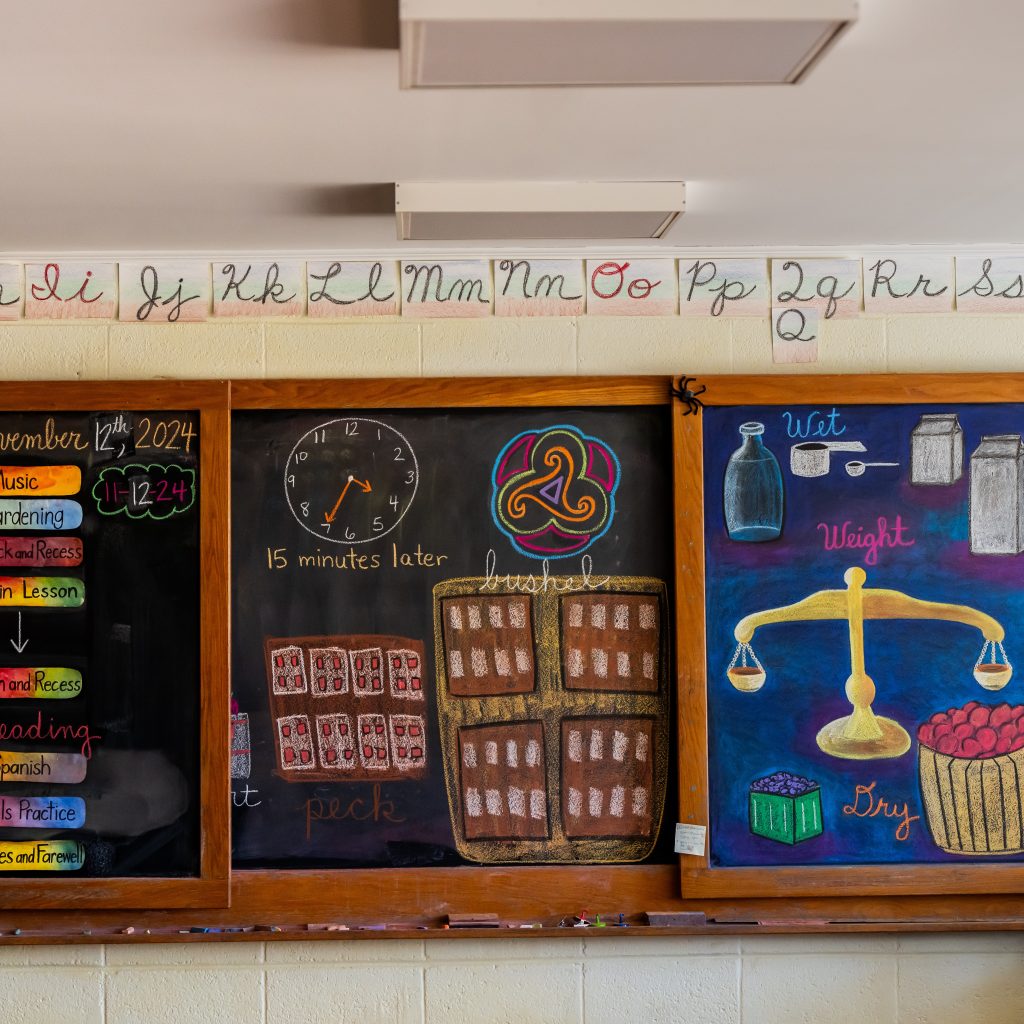
Let’s talk about Chalkboard Art

May 20, 2026 by Katherine Zuber

In a Waldorf school, the chalkboard is so much more than a teaching tool – it is a living piece of the classroom. Each drawing is created by hand by the teacher, often changing with the seasons, the curriculum, and the developmental stage of the children. From vibrant nature scenes to historical storytelling, geometric forms, poetry, and scientific illustrations, chalkboard art helps bring lessons to life in a beautiful and meaningful way.

In Waldorf education, beauty and imagination are considered essential parts of learning. These artistic classroom experiences invite students into wonder, help cultivate focus and reverence, and create an environment where learning feels alive and inspiring.

We are endlessly amazed by the creativity, care, and talent of our teachers, who spend countless hours transforming their classrooms with these incredible works of art. Every chalk drawing is a gift to the students, and a reflection of the love and intentionality woven into daily life at Kimberton Waldorf School.

Filed Under: Art Gallery, Head, Heart and Hands: Teaching the Whole Child, In the Classroom

Third Grade Agriculture Block at Seven Stars Farm

May 18, 2026 by Katherine Zuber

In Waldorf education, the 3rd grade Agriculture Block is a deeply meaningful crossing point in childhood development – a time when students begin to discover their own capability, responsibility, and place in the wider world.

This month, our 3rd graders spent two mornings a week at Seven Stars Farm caring for the animals and participating in the daily rhythms of farm life: sweeping the barn, feeding and watering the cows, mucking manure, and offering steady hands, gentle care, and loving attention.

Through this work, children experience something increasingly rare in modern childhood: real responsibility with real purpose. They learn that meaningful work matters, that communities function through cooperation, and that human beings are deeply connected to the land, animals, and one another.

And next week comes one of the most beloved traditions of all: the overnight farm stay. Students will sleep together in the garden building before waking at 4 AM to help milk the cows at dawn – an experience they will remember for years to come.

Filed Under: Bringing Waldorf Home, Head, Heart and Hands: Teaching the Whole Child, Homepage, Lower School

Pentathlon 2026!

May 18, 2026 by Katherine Zuber

Yesterday, our fields were filled with strength, courage, camaraderie, and joyful competition as five Waldorf schools gathered at Kimberton Waldorf School for the annual 5th Grade Pentathlon.

In the Waldorf curriculum, the study of Ancient Greece in fifth grade comes alive through the Pentathlon – where students step into the spirit of the Greek games they have been learning about in history, mythology, and literature. More than an athletic event, the Pentathlon is a celebration of balance: striving for excellence while honoring beauty, fairness, discipline, and community.

Students competed in javelin, discus, wrestling, high jump, and sprints, encouraging one another every step of the way. It was a beautiful day of determination, sportsmanship, and shared celebration – a meaningful culmination of their academic journey through Ancient Greece.

Filed Under: Bringing Waldorf Home, Homepage, Lower School

Kindergarten Walking Stick Project

May 4, 2026 by Katherine Zuber

Ahhh, the spring energy in the kindergarten! Our older children are SO ready to become first graders! So last week we began our big end of year project; crafting a walking stick to help us on the next stage of our school journey. We took a walk to the forest to hunt for just the right stick; not too thin, not too thick, not too short and not too tall. Once we had found the perfect sticks, we took our saw and carefully cut them to the perfect size then brought them back to the classroom and got to work.

We will spend the next few weeks, stripping the bark, sanding till they are smooth as silk and polishing them with beeswax polish till they shine.

This longer project, using real tools, instills a level of confidence in our older kindergarteners. It hones their hand eye coordination, improves their gross and fine motor skills and helps to increase their stamina and strengthens their will -all vital and important skills needed for their journey through the grades.

And what’s more they get to keep a beautiful and functional project that they created with their own two hands and will treasure for years to come.

Filed Under: Early Childhood, Head, Heart and Hands: Teaching the Whole Child, In the Classroom

May Faire

May 4, 2026 by Katherine Zuber

More May Faire magic, captured by 2nd grade parent Suraj Chaudhary.

Today’s May Faire was a joyful celebration of spring, community, and the magic that happens when we come together. The sun surprised us, the maypole danced, and joy filled every corner of campus – from flower crowns and fairy hair to music, laughter, and sweet treats. We ended the day along French Creek with our beloved boat race, the grand finale!

May Faire is a day of simple joys – dancing, laughter, handmade treasures, and time together. Rooted in tradition, it invites us to experience the harmony between human life and the blossoming world around us. See you next year, Morris Dancers and lemon sticks. 🍋

Filed Under: Bringing Waldorf Home, Homepage

Middle School Basket Making Elective

April 27, 2026 by Katherine Zuber

In the quiet rhythm of our middle school basket making elective, something beautiful unfolded. With patience, focus, and steady hands, students transformed simple natural materials into intricate, functional works of art.

In a world that often pulls attention in many directions, the ability to concentrate, listen to directions, and truly be present is a gift, and one our students continue to cultivate each day. Rooted in Waldorf education, these skills of focus and intention live not only in the mind, but in the hands and heart as well.

It’s no surprise that basket making came so naturally. When creativity is nurtured, and attention is honored, craftsmanship becomes an expression of the whole human being. Thank you Mr. Collier for bringing your basket skills to our middle school atrium for this four-week session!

Filed Under: Head, Heart and Hands: Teaching the Whole Child, In the Classroom, Lower School

A week in the life of a Kindergartener at KWS:

April 27, 2026 by Katherine Zuber

Harvesting violets and turning them into syrup… visiting the cows at Seven Stars Farm… noticing tiny blossoms along the trail to Mermaid’s Tail… wagon rides with friends… tending our kindergarten garden… watercolor painting, puppet shows, and bread baking… preparing soup together with little hands and full hearts…

All leading to a joyful kindergarten potluck, where our whole community gathers 🌸 it’s in these simple, meaningful rhythms that childhood is honored. wow—how lucky we are ✨

“A lovely Rainbow see it span, so brightly shining over our land.

It is so red, yellow and blue. I’d like to climb it now with you.” 🌈🎨

(painting day song)

Filed Under: Early Childhood, Head, Heart and Hands: Teaching the Whole Child

Ninth grade had a blast on their backpacking trip last week!

April 23, 2026 by Katherine Zuber

The group hiked along the Appalachian Tail with full packs, carrying everything they needed on their backs. They cooked on backpacking stoves, sitting around a fire each night cooking their dinner, sleeping in tents. A beautiful and uplifting week for our strong and capable freshmen class!

Filed Under: High School, Homepage, In the Classroom

Welcoming Arassari Pataxó for two unforgettable assemblies.

April 23, 2026 by Katherine Zuber

On Monday, our school community had the profound honor of welcoming Arassari Pataxó for two unforgettable assemblies.

Born in the heart of the Amazon rainforest, Arassari shared what it means to live in deep relationship with the land – where every choice we make ripples outward into our bodies, our rivers, and the Earth itself. Through story, humor, and lived experience, he invited our students to think more consciously about what we consume, how we care for nature, and how we show up in the world.

He reminded us that protecting Mother Earth begins with something simple yet powerful: Attention. Focus. Presence. Through a playful but challenging concentration game, students experienced firsthand how awareness lives not just in the mind, but in the body.

As a chief, artist, and advocate, Arassari carries the voice of the forest into every space he enters, whether through his environmental work, planting tens of thousands of native trees and restoring rivers, or through his art, which speaks when words cannot.

Filed Under: High School, Homepage, Kimberton Making News, Social Justice

Swinging Back in Time

April 14, 2026 by Katherine Zuber

by Courtney Diener-Stokes

Article written by KWS parent Courtney Diener-Stokes about other KWS parents Jesse Sychterz and Dan Tiffany. Originally published by the Reading Eagle.

Jesse Sychterz Tiffany of Kimberton, Chester County, was just 5 years old when she first began doing World War II reenactments with her grandmother. At the events, she received an introduction to swing dances, which were usually a part of the events.

“When I turned 18 I decided to take a lesson and became hooked,” she said. “Incidentally, my very first swing dance lesson was where I met my husband, Dan.

These days, you’re likely to find them on the dance floor at SunnyBrook Ballroom in Lower Pottsgrove Township, Montgomery County, on the first Sunday of each month in addition to other locations

“It’s the closest place that has swing dances,” Tiffany said. ”There’s a swing lesson from 3 to 4 p.m. followed by a live band from 4 to 7. Philadelphia also has an active swing dance scene, as well as Lancaster.”

One of her instructors over the years introduced her to dancing at retirement homes in Chester, Montgomery and Berks counties.

“My dance instructor at the time needed help at some demos and asked if I was interested because I looked the part,” Tiffany said. “I happily obliged and soon, quite a few activity directors from local nursing homes were asking us to come dance.”

When she goes to the homes, she is typically in period dress and takes a dance partner.

“One of the things I love most about dancing at these centers is I’ll catch residents, even with advanced Alzheimer’s, tapping their feet to the beat,” she said. “If I go up to them and take their hands you can feel their rhythm — you can just tell that 60-plus years prior they were cutting a rug.”

Some residents will stand up, and she’ll dance with them for as long as they’d like, while others might sit in their wheelchair and she’ll dance with them holding hands.

They perform various routines for residents that take them back in time.

“One of the routines is called the Tranky Doo, performed to the song ‘Dipsy Doodle’ by Ella Fitzgerald,” Tiffany said. “It’s a solo routine originally performed back in the early 1940s.”

Tiffany loves seeing residents reminisce when she dances for them.

“If it were not for their generation keeping this dance I love so dearly going, I wouldn’t have grown to know it, meet my husband through it, or have met all these wonderful people,” she said. “I think of it as a way to give back.”

Last year, Tiffany was invited to perform at a 100th birthday party with a few other dance friends.

“Boy did her face light up when she saw us dancing to some of her favorite tunes the way she used to 70 years prior,” she said.

Filed Under: Kimberton Making News

11th Grade Civil Rights Trip 2026

April 14, 2026 by Katherine Zuber

Our 11th grade journeyed south to complete their Civil Rights main lesson block with Mrs. Tonya Rice – walking across the Edmund Pettus Bridge, visiting the Legacy Museum, and standing in places that hold both pain and profound courage.

Through shared experience, thoughtful discussion, and deep reflection, history became something not just studied, but truly felt.

Filed Under: Blog, High School, Homepage, Resources

A sky full of color, laughter, and joy!

March 11, 2026 by Katherine Zuber

Today our community celebrated Holi, the traditional Indian Festival of Colors. Rooted in ancient stories and customs, Holi marks the arrival of spring and celebrates the triumph of good over evil, joy over darkness, and the renewal that comes with the changing seasons.

Students gathered together to toss bright powders into the air and at one another, filling the campus with vibrant clouds of color and laughter. This joyful tradition, celebrated across India and around the world, reminds us of the power of community, playfulness, and welcoming the new life that spring brings.

Happy Holi!

Filed Under: Blog, Head, Heart and Hands: Teaching the Whole Child, Homepage, Lower School, Resources

Life Aboard the Pequod!

March 9, 2026 by Katherine Zuber

As part of their Moby Dick block in 12th grade English, our seniors welcomed local knot expert Neal Collier to class for a hands-on exploration of the sailor’s craft woven throughout Herman Melville’s epic tale. In the novel, life aboard the Pequod depends on skill, cooperation, and an intimate knowledge of ropes – whether raising sails, lowering whaleboats, or navigating the unpredictable sea in pursuit of the great white whale.

Through tying and learning traditional knots themselves, students experienced a small piece of the maritime world Melville describes so vividly. This kind of experiential learning is central to Waldorf education: bringing literature off the page and into the hands, connecting intellect with practical skill, and deepening understanding through lived experience. A memorable afternoon of stories, rope, and a few well-tied knots for the Class of 2026.

Filed Under: Blog, High School, In the Classroom, Resources

Senior Self Portraits 2026

March 5, 2026 by Katherine Zuber

There is a special kind of quiet in the studio these days. Our seniors are deep in concentration, working on their final self-portrait projects.

With mirror work and printed photos of themselves, they practice the art of truly seeing. This isn’t just about capturing likeness; it’s about reflection in every sense of the word. Each brushstroke asks for focus, patience, and dedication – the same qualities that have carried them through their Waldorf journey. To look at oneself honestly, to observe light and shadow, strength and subtlety, requires courage and presence.

In Waldorf education, the senior self-portrait is more than a culminating art project. It is a moment of pause before graduation, a chance to reflect inwardly while creating outwardly. As they prepare to step into the wider world, our students first take the time to meet themselves with attention, care, and intention. Thank you Ms. Oswald for guiding them!

Filed Under: Art Gallery, Blog, High School, In the Classroom

Fifth Graders National Park Projects

March 5, 2026 by Katherine Zuber

From Yellowstone to the Everglades, our Fifth Graders have just completed their National Park projects, and what a journey it has been!

Each student chose a park to explore, wrote letters to real park rangers, dove into research through NPS.gov and local libraries, and transformed their discoveries into beautifully crafted Main Lesson books and detailed poster boards. The project culminated in oral presentations shared with middle school students and teachers – an opportunity to stand tall, speak clearly, and teach others what they’ve learned.

This is Waldorf education in action. Deep, interdisciplinary learning. Handwritten work that strengthens thinking. Art woven into academics. Real-world connection through letter writing. Public speaking that builds confidence and presence.

In Fifth Grade, students are stepping into a new sense of independence, and projects like this meet them right there. They research, create, synthesize, and present. They don’t just “do a report.” They become experts.

Filed Under: Blog, In the Classroom, Lower School, Resources

Of all the simple, powerful tools in a Waldorf kindergarten, puppetry holds a very special place.

March 2, 2026 by Katherine Zuber

Of all the simple, powerful tools in a Waldorf kindergarten, puppetry holds a very special place. Through gentle movement, rhythm, and story, puppetry speaks directly to the child’s imagination – meeting them where wonder lives.

When children watch a puppet story unfold, they aren’t just listening – they’re experiencing it. Puppetry nourishes language development, strengthens memory and attention, and lays an essential foundation for creative thinking and emotional understanding. Stories like The Grateful Statues, a Japanese fairy tale, invite children into a world of reverence, kindness, and gratitude, allowing moral qualities to be felt rather than explained.

In these quiet, magical moments, children practice deep listening, form vivid inner pictures, and begin to understand the world through imagination and empathy. This is the unseen work of early childhood: building capacities that will support learning, creativity, and human connection for years to come.

Filed Under: Blog, Development, Early Childhood, Head, Heart and Hands: Teaching the Whole Child, Resources

Ciara, Ona, and Josephine O’Hara Featured in Lilipoh!

February 26, 2026 by Katherine Zuber

In this month’s digital Lilipoh, we’re celebrating family and growth!

KWS graduate Ciara O’Hara ’24 shares a heartfelt essay about her bond with her little sister Josephine, while the Featured Author in this edition is Early Childhood Lead Teacher (and Ciara & Josephine’s Mom!) Ona O’Hara! Miss Ona pens the inspiring piece “How We Rise Is How We Raise” – a must read for all.

Click the link HERE to read both articles and be inspired by their stories of love, learning, and the impact of family.

Filed Under: Blog, Bringing Waldorf Home, Early Childhood, Kimberton Making News, Resources

Safaya Smallwood (KWS ‘20) Won Second Prize in the Prestigious Rylands Art Prize Competition

February 13, 2026 by Katherine Zuber

Alumni Update! Safaya Smallwood (KWS ‘20) won second prize in the prestigious Rylands Art Prize Competition. Safaya is currently pursuing her MPhil in African Studies at Cambridge University, after graduating from UPenn in 2024.

Safaya painted this portrait of her late Great Uncle, a professor of Civil Engineering at the University of Nsukka in Nigeria. Safaya included craft work in the painting, notably working with string and beading (for the sun of Biafra, the Ibo homeland that was lost to a horrific Civil War). Congratulations Safaya on winning this impressive and competitive Arts Competition!

Filed Under: Alumni, Blog, Resources

Platonic Solids in Grade 8

February 10, 2026 by Katherine Zuber

In Grade 8, students explore the five Platonic Solids – perfect shapes of balance and symmetry: cube, tetrahedron, octahedron, dodecahedron, and icosahedron.

Through folding, drawing, and constructing, geometry comes alive – not as abstraction, but as living wonder seen in crystals, flowers, and the hidden patterns of life. ♾️

Filed Under: Blog, In the Classroom, Lower School, Resources

Unity Rock Basketball Tournament

February 10, 2026 by Katherine Zuber

Spirit Week culminated with Day 1 of our annual Waldorf Basketball Tournament!

Seven Waldorf schools are gathering at Kimberton Waldorf School for three days of spirited play, sportsmanship, and community. Healthy competition among like-minded Waldorf schools is a beautiful thing. The winner on Sunday will take home the Unity Rock!

Our students had so much fun repping their KWS spirit, cheering on their classmates, and celebrating one another – on and off the court. Today’s only day one – see you at the next games this evening and tomorrow morning!

Filed Under: Blog, Homepage, Resources, Sports

College Acceptances Class of 2026

February 3, 2026 by Katherine Zuber

Seniors have been receiving good news in their inboxes this winter! The following colleges have admitted our students already. A name in bold indicates one of our students will attend.  A number of colleges will not make decisions until late March. We will keep you posted. Congratulations and good luck to our talented seniors from the College Guidance Department! -Anna Zay and Dr. Eva Goedhart

College Acceptances Winter 2026

Albany College of Pharmacy and Health Sciences

Boston Conservatory

Drexel University

Elon University

Evergreen State University

Fitchburg University

Gettysburg College

Hampshire College

Immaculata College

Ithaca College

Jefferson University

Lebanon Valley College

Muhlenberg College

Springfield College

Susquehanna University

Temple University (2)

Towson University

University of Buffalo

University Mass Amherst

University Mass Boston

University of Maine-Orono (3)

University of New England (2)

Warren Wilson (3)

Wilson College 

Ursinus College (3)

University of Richmond

University of Roanoke

University of Scranton

Vermont State University

Filed Under: Blog, High School, Homepage, Resources

Reverend Dr. Martin Luther King Jr. Day

January 20, 2026 by Katherine Zuber

Our Reverend Dr. Martin Luther King Jr. Day was a powerful and beautiful gathering of heart, voice, and community. 💙

The morning assembly featured moving performances, uplifting and emotional songs, and a keynote address by Dr. Selvi Kara, Assistant Professor of Mathematics at Bryn Mawr College, whose words invited deep reflection and inspiration. The assembly culminated with our Grades 5–12 chorus singing “When Dreams Take Flight,” filling the space with hope and purpose.

In the afternoon, students in Grades 8–12 continued the work through hands-on workshops rooted in the day’s theme, exploring poetry, dance, painting, music, and more. A day of art, reflection, and shared humanity—honoring Dr. King’s legacy through creativity, courage, and connection.

Filed Under: Blog, High School, Homepage, Resources

The Art of Education | 10 Minutes at KWS

January 15, 2026 by Katherine Zuber

Please enjoy this ten minute video made by KWS parent Luke O’Brien of LOCL Studios. Witness the magic of our 420 acre campus, see the learning and joy in action, and learn about the power and practicality of Waldorf education.

Filed Under: Blog, Bringing Waldorf Home, Resources, Vlog

Senior Night – Congratulations Seniors!

January 13, 2026 by Katherine Zuber

Senior Night is one of those evenings that reminds us what community truly means. Each January, we gather on our home court to celebrate our seniors – their accomplishments, their dreams, and the journey that brought them here. Walking through walls of classmates alongside their families, shaking the hands of our administrators, and hearing their goals spoken aloud, our seniors are held by the whole school community. A beautiful night of gratitude, pride, and belonging.

Filed Under: Blog, High School, Homepage, Resources, Sports

  • Page 1
  • Page 2
  • Page 3
  • Go to Next Page »

Footer

Connect

  • Facebook
  • Instagram
  • Twitter

Contact

410 West Seven Stars Road,
Phoenixville, PA 19460
Email us directly here

ph:610.933.3635  f:610.300.5488


Join our newsletter

Name

Menu

  • Current Students
  • Admissions
  • Faculty & Staff
  • Curriculum
  • Contact
  • Employment

Copyright © 2026 Kimberton Waldorf School